
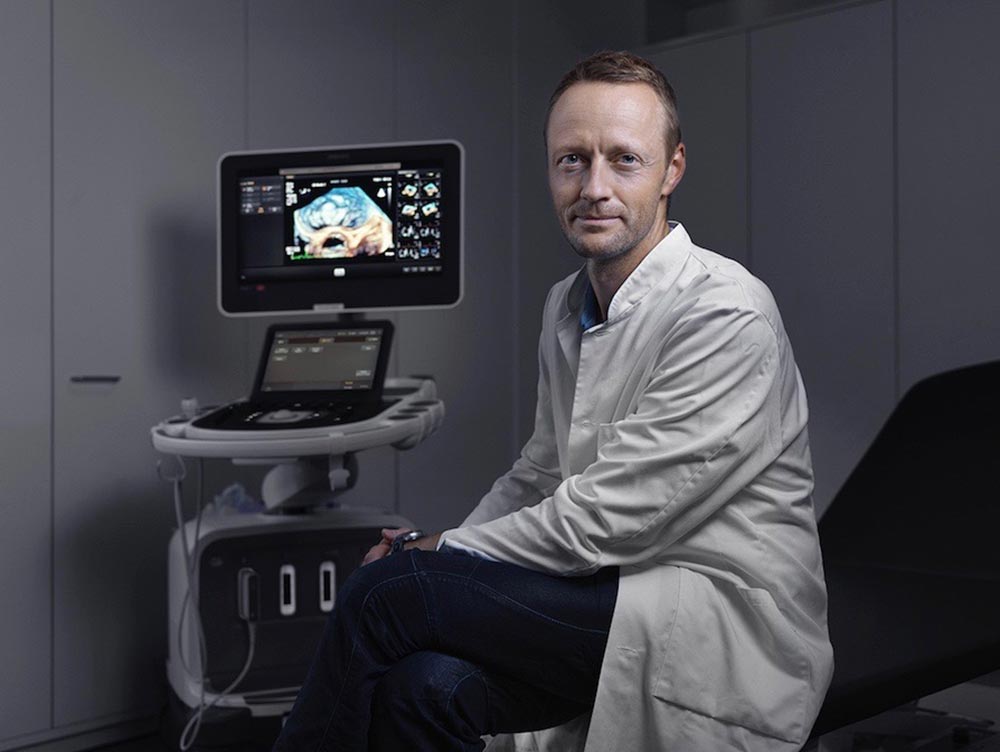
Imaging techniques of the heart (cardiac imaging):
Imaging of the heart (cardiac imaging) is essential for making a diagnosis.
Echocardiography
PD Dr. med. Patric Biaggi – Imaging Cardiology – HerzKlinik Hirslanden
Echocardiography continues to be the most important pillar in the detection of heart valve problems. 3D technology enables a more precise description of heart valves and their diseases. In particular, 3D transesophageal echocardiography provides detailed and ‘live’ information about the complex anatomy of the heart valves on the beating heart.
Computed tomography of the heart
Computed tomography of the heart (cardio-CT) has established itself as a complement to echocardiography in selected cases. Thanks to its high spatial resolution, it enables millimeter-precise measurements and intervention/surgery planning (selection of heart valve prosthesis size and type, access routes), particularly in the case of calcified heart valves. CT angiography of the coronary arteries (coro-CT) can also be used to detect and measure deposits and constrictions of the heart’s blood vessels.
Magnetic resonance imaging
Magnetic resonance imaging of the heart (cardio-MRI) is used to assess the structure of the heart muscle even more precisely. Cardiac MRI is an indispensable diagnostic tool for inflammatory diseases of the heart (myocarditis) or unclear heart muscle diseases (cardiomyopathies). Cardio-MRI is also excellent for checking that the heart muscle is adequately supplied with blood under stress and for visualizing measurements and scar tissue (e.g. after a heart attack)
Interventional cardiac imaging
In addition to diagnostic cardiac imaging, interventional cardiac imaging has played an increasingly important role in recent years, particularly in the case of heart valve diseases. In most cases, 3D transesophageal echocardiography is used. Percutaneous mitral or tricuspid valve reconstruction (catheter interventions on the beating heart without a direct view of the affected area) have only become possible at all thanks to this modern technology, as it virtually provides the map and the path for interventionalists.
The Heart Clinic develops and uses the latest fusion techniques, in which ‘live’ echocardiography images are fused with X-ray technology. This increases the precision and safety of highly complex procedures and in some cases shortens the intervention time.